Robert Frost
Thursday, March 28, 2013
"Acquainted with the Night"
"Acquainted with the Night"
Robert Frost
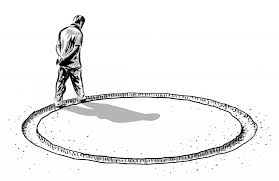 In this poem, Frost uses interlocking rhyme scheme. By using this rhyme scheme, Frost creates a sense of familiarity within each new stanza. The reader recognizes the words meant to rhyme and this creates a feeling that the rhyme has occurred previously. This feeling that the rhymes seem to go in a circular pattern contributes to the point of the poem that the speaker has gone on night walks multiple times. In addition, each stanza's rhyming words differ slightly from the previous stanza's. This shows that even though the pattern feels similar, each stanza is different. This relates to the speaker on his walks. The speaker has taken multiple walks at night, but because the rhyming words change from stanza to stanza, the speaker's walks probably differ from walk to walk. To add to the sense of repetition, Frost repeated the line "I have been one acquainted with the night" (Frost) at the beginning and the end of the poem. By repeating this line, Frost brings the poem full circle to give the sense of repetition. It also reinforces that the speaker has become acquainted with the night because he has repeatedly taken nighttime strolls.
Robert Frost

Dover Beach
"Dover Beach"
Matthew Arnold
 In this poem, each of the four stanzas explores an idea. The first explores thoughts of the English Channel remarking at its beautiful sight. However the first stanza notes the sorrowful sound of the water. This recognition leads to the second stanza which explores human misery. The third stanza focuses on a shrinking Sea of Faith. This figurative sea once was full and bursting at the seams. Now, the speaker notes, the sea is draining. "But now I only hear /Its melancholy, long, withdrawing roar" (Arnold). This sea of faith could be applied to humanity in general, but it can also be applied specifically to the speaker. Because the sea is draining, this implies that the speaker once had faith but now does not.
Matthew Arnold
The speaker is lamenting the decline of religious faith in his time. Is he himself a believer? Does he see any medicine for the world's maladies?
In the fourth stanza, the speaker expresses that he has no cure for the lack of faith. Instead he says "Ah, love, let us be true/ To one another" (Arnold). Never in the fourth stanza does the speaker state that the way to cure the world maladies arises through an increase of faith. Instead the speaker suggests that instead of trying to fix the problem, people should find someone to rely on through life that "Hath really neither joy, nor love, nor light,/ Nor certitude, nor peace, nor help for pain" (Arnold).
Sorting Laundry
"Sorting Laundry"
Elisavietta Ritchie
 In this poem, Ritchie uses an extended metaphor of folding laundry to represent the speaker's relationship. By describing the different pieces of laundry such as the sheets, towels, and shirts, that the speaker is folding, the speaker also describes her relationship. "Pillowcases, despite so many/washings, seams still/ holding our dreams" (Ritchie). The speaker's relationship is old as shown in the phrase "so many washings". Despite its length, the relationship is still strong as described by the
"seams still holding our dreams". The pillow case shows that no matter how old the relationship may be, it has remained strong throughout time. Another description of clothing describes "all those wrinkles/ to be smoothed, or else/ ignored" (Ritchie). The wrinkles in the couple's clothing represents problems in their relationship. Despite their problems, the couple has remained together. The couple has been able to work through some problems as described by the phrase "to be smoothed". In addition, the couple has also ignored some problems. The couples problems were small enough to work through or ignore which suggests that the couple has a stable relationship.
Elisavietta Ritchie
"seams still holding our dreams". The pillow case shows that no matter how old the relationship may be, it has remained strong throughout time. Another description of clothing describes "all those wrinkles/ to be smoothed, or else/ ignored" (Ritchie). The wrinkles in the couple's clothing represents problems in their relationship. Despite their problems, the couple has remained together. The couple has been able to work through some problems as described by the phrase "to be smoothed". In addition, the couple has also ignored some problems. The couples problems were small enough to work through or ignore which suggests that the couple has a stable relationship.
Wednesday, March 27, 2013
Vanity Destroyed
"The Convergence of the Twain"
Thomas Hardy
In this poem, Hardy uses vivid images to describe sunken lavish ship aka the Titanic. In his use of imagery, Hardy conveys the differences between the extravagant ship and the ocean. For example, "Jewels in joy designed/ To ravish the sensuous mind/ Lie lightless, all their sparkles bleared and black and blind" (Hardy). This quote expresses the brilliance of the Titanic as it was before it sunk through "Jewels in joy designed" and "sparkles". These phrases sound appealing to the reader and evoke pictures of wealth. Hardy contrasts these images of wealth with the phrase "bleared and black and blind". This phrase expresses that the sea caused the demise of the vanity of the ship. In addition to this phrase, other phrases like "The sea-worm crawls- grotesque, slimed, dumb, indifferent"(Hardy) also help to show that such a proud, lavish ship did not belong in the ocean. By contrasting the different settings (sea vs. ship), Hardy suggests that such a massive object of vanity was not suitable to cross the ocean. Further, this same contrast in setting could be applied to express that human vanity will cause our demise. A lavish ship sunk in the middle of the ocean because its pride did not allow it to properly navigate around an iceberg. The ship's vanity blinded the people of its possibility to sink. Similarly, our own pride and vanity can blind us from our possibility of failing. By simplifying our lives, we can focus on the truly important tasks and can become successful people.
Thomas Hardy
In this poem, Hardy uses vivid images to describe sunken lavish ship aka the Titanic. In his use of imagery, Hardy conveys the differences between the extravagant ship and the ocean. For example, "Jewels in joy designed/ To ravish the sensuous mind/ Lie
Thursday, February 28, 2013
"My Mistress' Eyes"
"My Mistress' Eyes"
William Shakespeare
When reading the title of this poem, the reader might initially think that this poem will be a sappy love poem. However, this poem expresses the speaker's view that other things are more beautiful or appealing than his mistress. The majority of the poem lists his mistress' shortcomings. "Coral is far more red than her lips' "; And in some perfumes is there more delight /Than in the breath that from my mistress reeks"; music hath a far more pleasing sound" (Shakespeare). For a majority of the poem, the reader can imply that the speaker is not fond of his mistress. However, a major shift occurs at the end of the poem. "And yet, by heave, I think my love as rare / As any she belied with false compare" Shakespeare). "And yet" clearly indicates to the reader that the speaker's tone will change. The speaker states that his love for his mistress is rare. His rare love matches with the rarity of the mistress' features as described earlier in the poem. Essentially, Shakespeare used the first twelve lines of the poem to describe unique traits of his mistress in a somewhat backhanded compliment way only to shift in the last two lines to say that he loves this rarity of the woman.
William Shakespeare
When reading the title of this poem, the reader might initially think that this poem will be a sappy love poem. However, this poem expresses the speaker's view that other things are more beautiful or appealing than his mistress. The majority of the poem lists his mistress' shortcomings. "Coral is far more red than her lips' "; And in some perfumes is there more delight /Than in the breath that from my mistress reeks"; music hath a far more pleasing sound" (Shakespeare). For a majority of the poem, the reader can imply that the speaker is not fond of his mistress. However, a major shift occurs at the end of the poem. "And yet, by heave, I think my love as rare / As any she belied with false compare" Shakespeare). "And yet" clearly indicates to the reader that the speaker's tone will change. The speaker states that his love for his mistress is rare. His rare love matches with the rarity of the mistress' features as described earlier in the poem. Essentially, Shakespeare used the first twelve lines of the poem to describe unique traits of his mistress in a somewhat backhanded compliment way only to shift in the last two lines to say that he loves this rarity of the woman.
"Barbie Doll"
"Barbie Doll"
Marge Piercy
In this poem, a beautiful young girl faces peer pressure as she goes through puberty. The people around stress how unattractive they view her nose and legs. "Everyone saw a fat nose on thick legs" (Piercy). The diction that Piercy uses helps to emphasize this point. The phrase is not 'Everyone saw a fat nose and thick legs. The phrase specifically uses the preposition on. This preposition helps to express that these two features of the young girl are they only features that people see of her. The young girl tries to change in order to appeal to society, and she dies from it. When she is in her casket people finally say that she looks beautiful. This outrageous end expresses a strong point. People should not focus on the outer appearance of others because they will miss the hidden beauties of the individual. in this poem, the people could not see that "She was healthy, tested intelligent, possessed strong arms and back, ..." (Piercy). In addition, people should not try to change their appearance to please others because it will bring harm to themselves, maybe not through death but at least in a dishonesty to their unique being.
Marge Piercy
In this poem, a beautiful young girl faces peer pressure as she goes through puberty. The people around stress how unattractive they view her nose and legs. "Everyone saw a fat nose on thick legs" (Piercy). The diction that Piercy uses helps to emphasize this point. The phrase is not 'Everyone saw a fat nose and thick legs. The phrase specifically uses the preposition on. This preposition helps to express that these two features of the young girl are they only features that people see of her. The young girl tries to change in order to appeal to society, and she dies from it. When she is in her casket people finally say that she looks beautiful. This outrageous end expresses a strong point. People should not focus on the outer appearance of others because they will miss the hidden beauties of the individual. in this poem, the people could not see that "She was healthy, tested intelligent, possessed strong arms and back, ..." (Piercy). In addition, people should not try to change their appearance to please others because it will bring harm to themselves, maybe not through death but at least in a dishonesty to their unique being.
"A Jury of Her Peers"
"A Jury of Her Peers"
Susan Glaspell
As the reader discovers early on in this short story, Mrs. Wright killed her husband. The question of the story is 'What provoked her to kill her husband'? As the men of the story search for this motive, the anticipation of the discovery creates suspense for the reader. Ironically, the Mrs. Hale and Mrs. Peters, who the men viewed as inferior, found clues that piece together to form Mrs. Wright's motive. As the two women wait for their husbands to find clues to the mystery, the ladies wait in Mrs. Wright's house and begin to straighten up the kitchen. In doing this, the women stumble upon some interesting objects such as the bird cage without a bird, a pristine quilt with only a few patches sewn frantically, and half a bag of sugar transferred from the bag. These first few discoveries cause the women to suspicion that something made Mrs. Wright stop in the middle of her work and also made her nervous. However, the women never said aloud that Mrs. Wright killed her husband. Later the women also discover the use of the birdcage by finding a dead bird among Mrs. Wright's sewing materials. The bird's neck had been wrung, and with this information the suspense grew because now the women knew that the death of this bird, possibly Mrs. Wright's only companion, caused her to kill her husband because he had wrung its neck. The women empathized with Mrs. Wright and her loneliness. They decided that she should not be found guilty for her actions, so they decided to take the bird and conceal it. "Desperately she opened it, started to take the bird out...and got it in the pocket of her big coat just as the sheriff and the county attorney came back into the kitchen" (Glaspell). The ladies were the jury for Mrs. Wright because they decided on her innocence and concealed the only clue to Mrs. Wright's motive.
Susan Glaspell
As the reader discovers early on in this short story, Mrs. Wright killed her husband. The question of the story is 'What provoked her to kill her husband'? As the men of the story search for this motive, the anticipation of the discovery creates suspense for the reader. Ironically, the Mrs. Hale and Mrs. Peters, who the men viewed as inferior, found clues that piece together to form Mrs. Wright's motive. As the two women wait for their husbands to find clues to the mystery, the ladies wait in Mrs. Wright's house and begin to straighten up the kitchen. In doing this, the women stumble upon some interesting objects such as the bird cage without a bird, a pristine quilt with only a few patches sewn frantically, and half a bag of sugar transferred from the bag. These first few discoveries cause the women to suspicion that something made Mrs. Wright stop in the middle of her work and also made her nervous. However, the women never said aloud that Mrs. Wright killed her husband. Later the women also discover the use of the birdcage by finding a dead bird among Mrs. Wright's sewing materials. The bird's neck had been wrung, and with this information the suspense grew because now the women knew that the death of this bird, possibly Mrs. Wright's only companion, caused her to kill her husband because he had wrung its neck. The women empathized with Mrs. Wright and her loneliness. They decided that she should not be found guilty for her actions, so they decided to take the bird and conceal it. "Desperately she opened it, started to take the bird out...and got it in the pocket of her big coat just as the sheriff and the county attorney came back into the kitchen" (Glaspell). The ladies were the jury for Mrs. Wright because they decided on her innocence and concealed the only clue to Mrs. Wright's motive.
Subscribe to:
Posts (Atom)